
How to Use AI to Grow a Business in 2026: A Guide
AI Strategy, Business Transformation, Operating System Thinking
AI Is No Longer a Tool—It’s the Operating System of Your Business (Here’s How to Build It)
Imagine waking up to find that a competitor with half your headcount is suddenly outrunning you on every front—faster campaigns, sharper messaging, tighter operations, happier customers. They’re not working harder. They’re not even necessarily smarter. They’re running a different operating system.
For years, businesses treated artificial intelligence like a shiny add‑on: a chatbot here, a recommendation engine there, an experiment in the corner. That era is over. AI has moved from being a single app on your “business desktop” to becoming the operating system that powers everything underneath —from how you attract customers to how you price, deliver, and grow. The organizations that understand this shift, and deliberately build an AI operating system, will outpace those who keep bolting on tools and hoping for the best.
From Tool to Operating System: Why This Shift Matters Now
Think about your computer. The operating system doesn’t just run one program; it coordinates memory, security, applications, and hardware. It quietly orchestrates everything in the background so you can work smoothly. In the same way, an AI operating system for your business is not a single model or app. It’s the invisible intelligence layer that:
Knits together data from marketing, sales, operations, and finance into a shared brain
Automates routine work and routes decisions to the right people or systems in real time
Learns continuously from every interaction and outcome, improving over time
When AI is just a tool, it sits in a silo. When AI becomes the operating system, it shapes how your organization thinks, decides, and acts. That distinction is what separates incremental improvement from step‑change transformation.
📌 Key Insight from Lavell Frost: The moment you stop treating AI like a side project and start treating it like infrastructure, your growth curve changes.
“Organizations that successfully scale AI treat it as a system‑level capability embedded across processes and decision‑making, not as isolated pilots.”
— McKinsey Global Institute, The State of AI in 2023
Why AI as an Operating System Is So Important for Businesses and Agencies
For businesses and agencies, the value of AI is no longer just about efficiency. It is about compounding advantage . An AI operating system gives you four strategic benefits that tools alone cannot deliver:
Unified intelligence across the customer journey. Instead of separate AI for ads, email, and support, your operating system sees the entire journey—who clicked, who asked a question, who bought, who churned—and optimizes end‑to‑end experiences, not isolated moments.
Faster, higher‑quality decisions. AI becomes the first pass on every decision: which leads to prioritize, which campaigns to scale, which clients to upsell, which projects to pause. Humans move from collecting data to judging and steering.
Scalable personalization and delivery. Agencies can serve more clients at higher quality; businesses can serve more customers with fewer bottlenecks. Your operating system standardizes how work gets done, then customizes outputs at scale using AI.
Continuous learning loop. Each campaign, proposal, support ticket, and sale becomes training data. The system gets smarter, and your competitive edge grows with every interaction instead of resetting to zero after each project.
📌 Key Takeaway: Treating AI as an operating system forces you to design for connection, orchestration, and learning—not just isolated automation.
“Companies that embed AI across their organizations are seeing profit margins 3–15% higher than peers, and revenue growth up to 10% higher.”
— MIT Sloan Management Review & BCG, The AI Powered Organization
Step 1: Define the Role of Your AI Operating System
Before you buy tools or hire specialists, clarify what your AI operating system is meant to do. This is a strategic design question, not a technical one. Start with three lenses: value, scope, and guardrails.
Clarify the Value: What Should AI Make True That Isn’t True Today?
For an agency , it might be: “We can create, test, and optimize high‑performing campaigns 3x faster without sacrificing quality.”
For a B2B company , it might be: “Every sales rep has a 360‑degree, AI‑generated brief before each call, based on live data.”
For a service business , it might be: “No customer waits more than five minutes for a meaningful, personalized response.”
Turn this into a one‑sentence vision: “Our AI operating system will …” and make it ambitious but practical. This statement becomes your north star for every build decision.
💡 Pro Tip from Lavell Frost: If your AI vision doesn’t feel a little uncomfortable, it’s probably not ambitious enough to move the needle.
Define the Scope: Where Will AI Orchestrate vs. Assist?
Your operating system will not replace every human decision, nor should it. Map your workflows and label each step:
AI‑led: Tasks AI can fully own (e.g., drafting first‑pass copy, routing support tickets, generating reports).
AI‑assisted: Tasks where AI proposes options and humans decide (e.g., pricing adjustments, campaign concepts, hiring shortlists).
Human‑led: Tasks that remain primarily human (e.g., negotiation, creative direction, complex client strategy) but are still informed by AI insights.
Set Guardrails: What Are the Non‑Negotiables?
As AI becomes foundational, you need clear rules: data privacy standards, brand voice guidelines, approval workflows, and risk thresholds. Your operating system should encode these guardrails so they are enforced automatically, not just written in a policy document no one reads.
💡 Pro Tip: Write a one‑page “AI Constitution” that states what AI can and cannot do in your organization. Use it to align leadership and teams before you build.
“Responsible AI requires governance that is embedded into systems and workflows, not bolted on. Clear guardrails are essential to scale safely.”
— World Economic Forum, AI Governance Alliance Report
Step 2: Build the Foundations—Data, Workflows, and Interfaces
An operating system is only as good as what it can see and control. In business terms, that means your data, your workflows, and your interfaces with people and tools. You don’t need perfection to start, but you do need a solid foundation.
1. Connect the Right Data, Not All the Data
Many AI initiatives stall because they chase a mythical “single source of truth” before doing anything useful. Instead, start with critical data slices that directly support your operating system vision. For example:
Marketing: campaign performance, audience segments, creative variations, spend by channel
Sales: CRM records, win/loss reasons, call notes or transcripts, deal size and cycle time
Service: tickets, FAQs, resolution times, customer satisfaction scores, escalations
Your goal is a minimum viable “brain” that can understand what’s happening across the customer lifecycle and feed that into AI models. This can be as simple as connecting your CRM, help desk, and analytics tools into a central warehouse or AI platform.
2. Map and Standardize Your Core Workflows
AI thrives on repeatable patterns. If every team member runs their own version of a process, your operating system will struggle. Choose three to five core workflows—such as campaign creation, sales outreach, onboarding, or reporting—and document them step by step:
What triggers the workflow?
Who is involved, and what tools do they use?
What decisions are made, and based on what information?
What does “good” look like, and how is it measured?
Once standardized, these workflows become candidates for AI orchestration: automatically triggering tasks, drafting outputs, flagging anomalies, and surfacing recommendations at each step.
3. Design Human‑Friendly Interfaces to the AI Layer
Your AI operating system is only as powerful as the interfaces your teams actually use. That might look like:
A single “AI workspace” where staff can ask questions, generate drafts, and analyze performance within the tools they already use
Contextual assistants embedded in your CRM, project management, or support platform that surface AI suggestions at the moment of work
Executive dashboards that don’t just show metrics but explain why things are happening and what to do next
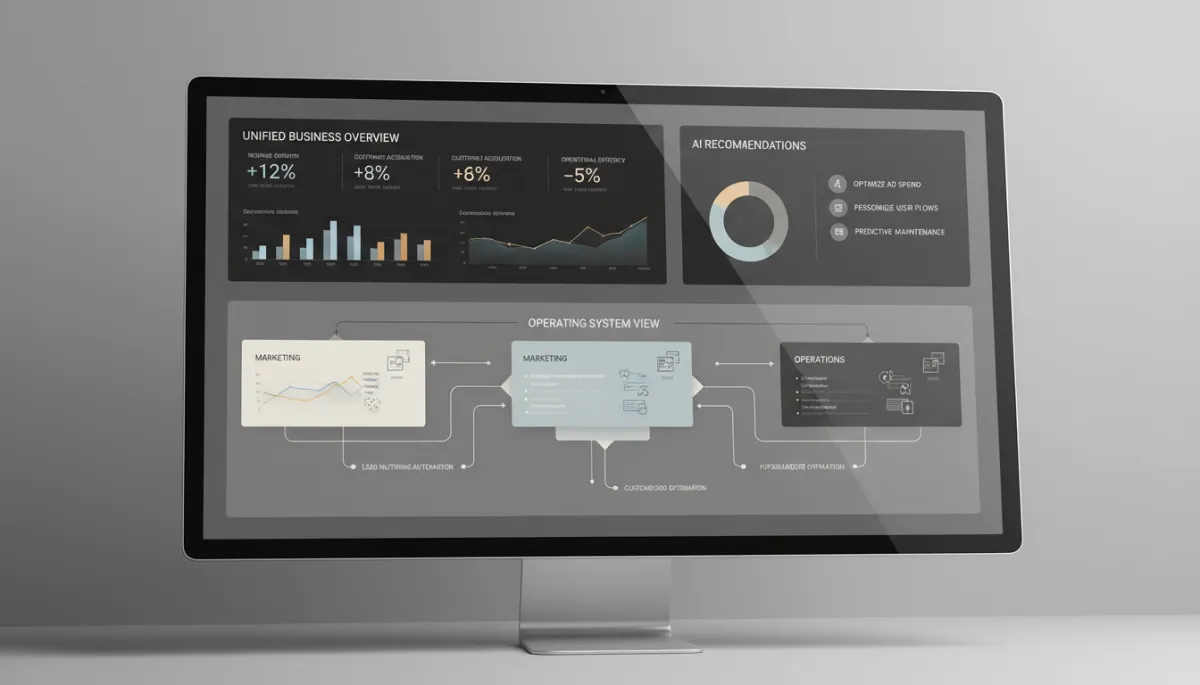
A unified AI layer turns scattered metrics into clear, prioritized actions for every team.
💡 Research Spotlight: In a survey of 1,000+ firms, those that integrated AI into core workflows—not just dashboards—were 1.6x more likely to report significant cost savings and revenue gains (Accenture, AI: Built to Scale ).
Step 3: Orchestrate Use Cases, Not Just Models
Many organizations start with “Which model should we use?” The better question is, “Which use cases will create the most leverage if they share the same brain?” Your AI operating system should orchestrate a portfolio of connected use cases, not a collection of unrelated experiments.
Prioritize High‑Leverage, Reusable Use Cases
Look for activities that are:
Frequent: Happen daily or weekly, not once a quarter
Standardized: Follow a recognizable pattern or template
Impactful: Directly tied to revenue, cost, or customer experience
For agencies, that might include campaign briefs, creative variations, performance reporting, and proposals. For businesses, think lead scoring, sales email drafting, support responses, and churn risk alerts. Design AI flows that reuse the same data, knowledge, and patterns across all of these, so each use case strengthens the others.
Chain AI Capabilities Like Apps in an Ecosystem
Your operating system will likely use multiple AI capabilities—language models, prediction models, recommendation engines, and more. The power comes from chaining them together around a workflow. For example:
A model analyzes historical campaign data to identify winning patterns
A language model generates new creative concepts aligned with those patterns and your brand voice
An optimization engine allocates budget and channels based on predicted performance
A monitoring agent watches live results and recommends adjustments in real time
To your teams, this appears as a single, intelligent campaign engine. Under the hood, your AI operating system is orchestrating multiple specialized models in a coordinated way.
📌 Expert View: Gartner predicts that by 2026, organizations that operationalize AI across multiple connected use cases will outperform peers by 25% in customer satisfaction and operational efficiency.
Step 4: Embed Governance, Ethics, and Trust from Day One
When AI is just a tool, a mistake is annoying. When AI is your operating system, a mistake can ripple through the entire organization. That’s why governance is not an afterthought—it is part of the architecture.
Define Clear Ownership and Decision Rights
Decide who owns the AI operating system: a central AI team, a digital transformation office, or a cross‑functional steering group. Clarify:
Who approves new AI use cases and models
Who monitors performance, bias, and compliance risks
Who responds when something goes wrong and how quickly
Build Transparency and Human Oversight into the System
Your operating system should explain itself. Whenever AI makes or suggests a decision, give users:
The reasoning or factors considered (in plain language)
The confidence level or uncertainty
A clear way to override, correct, or escalate the decision
📌 Key Takeaway: Trust is a feature. When people understand how the AI operating system works and where its limits are, adoption and impact skyrocket.
“Explainability, human oversight, and clear accountability are core to trustworthy AI. Systems that embed these principles earn significantly higher user confidence.”
— European Commission, Ethics Guidelines for Trustworthy AI
Step 5: Develop AI‑Ready People, Not Just AI‑Powered Systems
An AI operating system changes the nature of work. Your teams shift from doing everything manually to supervising, steering, and amplifying AI. Without intentional upskilling, you’ll end up with powerful capabilities that few people know how to use well.
Train Teams in “AI Collaboration,” Not Just Tool Usage
Go beyond one‑off training on specific tools. Teach people how to:
Ask better questions and give better prompts to AI systems
Evaluate AI outputs critically and refine them efficiently
Design workflows that combine human strengths and machine strengths intentionally
Create AI Champions Inside Each Function
Identify early adopters in marketing, sales, operations, HR, and finance. Give them deeper training and empower them to:
Gather feedback from their teams about what’s working and what’s not
Propose new use cases and improvements to the central AI team
Model healthy, responsible use of AI in day‑to‑day work
📌 Research Insight: According to Deloitte’s State of AI in the Enterprise , organizations that invest in broad AI skills development are 2.5x more likely to achieve significant business outcomes from AI.
Step 6: Start Small, Then Scale with a Clear Roadmap
Building an AI operating system might sound like a multi‑year, multi‑million‑dollar project. It doesn’t have to be. The key is to start small, deliver visible wins, then scale deliberately.
Launch a Pilot “AI OS” in One Business Area
Choose a single domain—such as demand generation for agencies or customer support for product companies—and implement the full stack there:
Connected data sources specific to that domain
Standardized workflows and clear KPIs
Orchestrated AI capabilities that support the entire workflow, not just one task
Run the pilot for 60–90 days. Measure impact on speed, quality, revenue, and satisfaction. Use those results to refine your design and build internal momentum.
Scale Horizontally Across Functions, Then Vertically in Depth
Once your pilot is working, replicate the operating system pattern across other functions—sales, finance, HR—while reusing as much of the underlying AI layer as possible. Over time, deepen each area with more advanced models, richer data, and tighter integration. The result is a cohesive, organization‑wide AI operating system that grew from proven, value‑driven pilots instead of abstract blueprints.
📌 Key Takeaway: Research from PwC estimates that AI could contribute $15.7 trillion to the global economy by 2030—much of it captured by organizations that scale AI systematically rather than through isolated experiments.
Bringing It All Together: Your Next Moves in the Age of AI Operating Systems
AI as a tool was optional. AI as the operating system of your business is rapidly becoming non‑negotiable. Competitors are already using unified AI layers to respond faster, personalize deeper, and scale smarter. The question is not whether you will build an AI operating system, but how intentionally you will do it.
To recap, the path forward looks like this:
Define the role of AI in your business: what it should make possible, where it will orchestrate, and what guardrails it must respect.
Lay the foundations with connected data, standardized workflows, and human‑friendly interfaces.
Orchestrate high‑leverage use cases that share the same brain and compound value across the customer journey.
Embed governance and trust so your operating system is safe, explainable, and aligned with your brand and values.
Invest in people who can collaborate with AI, champion change, and continuously improve the system.
Start small, then scale with a clear roadmap from pilot to enterprise‑wide operating system.
“An AI operating system doesn’t just cut costs; it changes what you’re capable of. It’s the difference between playing catch‑up and setting the pace.”
— Lavell Frost
For businesses and agencies, the opportunity is enormous. An AI operating system doesn’t just cut costs; it changes what you are capable of delivering. It lets small teams punch far above their weight. It turns data into decisions, decisions into actions, and actions into learning—on repeat, every day, across every function.
The organizations that win in the next decade will be those that stop asking, “Which AI tools should we try?” and start asking, “How do we design and run the AI operating system of our business?” The good news is you don’t need to have all the answers to begin. You only need the willingness to start, learn fast, and treat AI not as a gadget, but as the new foundation on which your entire business runs.
📌 Clear Summary: AI as an operating system means building a unified intelligence layer that connects your data, standardizes your workflows, orchestrates your highest‑leverage use cases, embeds governance and trust, and equips your people to collaborate with AI every day. When you approach AI this way, you don’t just optimize individual tasks—you redesign how your whole business thinks, decides, and grows.
🚀 Ready to Turn This Strategy into Reality? If you want a practical way to build and run an AI operating system for your funnels, campaigns, and client delivery, visit UltimateFunnels.com . That’s where my team and I, break this down into step‑by‑step systems you can plug into your business today.
Don’t wait until a competitor’s AI operating system makes your current playbook obsolete. Block 30 minutes this week to map your first pilot area, then head over to UltimateFunnels.com to see how to turn that vision into a working AI OS—complete with connected data, orchestrated workflows, and proven funnels you can deploy immediately.